
Facial Palsy

- Specialist assessment of facial nerve function
- Treatment across the full spectrum of facial palsy
- All consultations free with no obligation
- Internationally trained specialist surgeons
- Complete aftercare included
A Personalised Approach to Facial Palsy Treatment
Facial palsy affects the nerve that controls facial movement, leading to weakness or paralysis that can alter how a person smiles, blinks, or expresses emotions. For many patients, the condition has been present for years, often following a diagnosis of Bell’s palsy, Ramsay Hunt syndrome, or nerve damage from surgery or injury, without ever being offered treatment that addresses the underlying weakness.
At Ullas Facial Plastic Surgery, we treat facial palsy across its full spectrum, from early symptom management through to reconstructive nerve surgery. Every treatment plan begins with a detailed assessment of exactly how the nerve is affected, since no two patients present in quite the same way.
If your facial weakness has come on suddenly, seek medical help straight away. Sudden facial drooping can be a sign of stroke, particularly alongside arm weakness or difficulty speaking, and needs emergency assessment. Whereas in Bell’s palsy, treatment works best when started within about 72 hours of onset, so contact your GP or attend an urgent care service the same day. If your eye will not close fully, ask for advice on protecting it without delay. The NHS guidance on Bell’s palsy sets out what to do.
About
What is Facial Palsy?
Facial palsy describes a weakness or complete loss of movement in the muscles on one side of the face, caused by damage of some sort to the facial nerve. The nerve controls the muscles responsible for smiling, closing the eye, raising the eyebrow and forming other facial expressions, so damage at any point along its path can affect one or several of these functions.
The degree of weakness varies considerably between patients, from mild asymmetry only noticeable when smiling, to a complete loss of movement on one side of the face. Some patients also develop synkinesis, where nerve fibres regrow abnormally and cause unwanted or involuntary movements alongside the intended ones. This can happen years after the palsy.
This content has been medically reviewed by Mr Gautham Ullas BMBS, BMedSci, FRCS (ORL-HNS).
What Can Cause Facial Palsy?
Facial palsy can develop for a number of reasons, and identifying the underlying cause is an important part of planning the right treatment. There are many recognised causes, and misdiagnosis is a frequently reported problem, which makes an accurate assessment of the underlying cause an important first step. Some cases resolve partially on their own, while others benefit significantly from surgical or non-surgical intervention.
Bell’s (idiopathic) palsy is the most common cause, accounting for the majority of cases, with a widely cited lifetime risk of around 1 in 60 to 1 in 70 people developing it at some point.
Common causes include:
- Bell's palsy
- Ramsay Hunt syndrome
- Nerve damage following ear, parotid or skull base surgery
- Facial trauma or injury
- Tumours affecting the facial nerve
- Congenital facial nerve weakness
- Lyme disease
- Stroke
- Middle ear infection
- Multiple sclerosis
Clinicians broadly distinguish between weakness arising above the facial nerve nucleus (known as an upper motor neurone pattern, typically associated with stroke and other central causes, and which usually spares the forehead) and weakness arising below it (a lower motor neurone pattern, as seen in Bell’s palsy and Ramsay Hunt syndrome, which typically affects the whole side of the face including the forehead). This distinction is central to why sudden facial weakness needs urgent assessment, see the notice above.
Benefits
What are the Benefits of Facial Palsy Treatment?
Facial palsy affects far more than appearance, often influencing how comfortable someone feels speaking, eating or simply being seen in public. Patients frequently describe the benefits of treatment in terms of confidence and social ease as much as physical movement.
Benefits can include:

Improved facial symmetry at rest

Restored or improved smile movement

Reduced involuntary movements caused by synkinesis

Better eye closure and protection

Increased confidence in social situations

A treatment plan tailored to your specific pattern of weakness
Facial Palsy UK, the national charity for people affected by facial paralysis, provides information, patient guides and peer support, including guidance on eye care and access to support groups.
our Candidates
Am I a Good Candidate for Facial Palsy Treatment?

Anyone living with facial weakness, whether it developed recently or many years ago, may benefit from an assessment, since treatment options exist for a wide range of causes and severities. Patients are often surprised to learn that longstanding weakness, sometimes present for decades, can still respond well to treatment, and suitability is determined individually based on nerve function, the cause of the palsy and the patient’s goals.
How Is Facial Palsy Treated?
Treatment for facial palsy is planned around the specific pattern of weakness present, how long it has been established, and whether any movement remains. Options range from non-surgical techniques that rebalance the face to surgical nerve reconstruction that aims to restore active movement.
Chemodenervation is often used to manage synkinesis, relaxing overactive muscles so the rest of the face can move more naturally. Where movement has been absent for a long period, dynamic reanimation techniques can reintroduce active movement, while static procedures improve symmetry at rest for patients who are not suitable for, or do not want, a dynamic approach.
Your journey
Your Facial Palsy Treatment Journey at Ullas Facial Plastic Surgery
Every facial palsy treatment plan at Ullas Facial Plastic Surgery is built around individual nerve function and goals. The treatment journey is designed to give clarity and support at every stage.
Your consultation is free and carried out directly with a facial plastic surgeon with specialist experience in facial nerve reconstruction, allowing time to assess nerve function and discuss the range of treatment options available. A second complimentary consultation is also offered, giving time to consider the options before deciding how to proceed.
Facial palsy affects the whole face. It is very common to have the brow sag down causing skin to fall over the visual field. The eyelid closure muscle can get paralysed allowing you to open but not close the eye. This can cause dryness and watering. The orbicularis oculi is also pumping the tears across the eye and into the tear drainage system. With palsy it can no longer do so and the tear drainage system is pulled away from the eyeball. We provide comprehensive treatment including surgery to allow eye closure, surgery to improve the position of the brow and eyelid.
Treatment varies considerably depending on the approach chosen, from chemodenervation performed in clinic, to surgical nerve reconstruction carried out under general anaesthesia. Your surgeon will explain exactly what your specific procedure involves once a treatment plan has been agreed upon.
Results depend on the type of treatment provided. Chemodenervation typically shows improvement within one to two weeks, while surgical reanimation techniques develop gradually over several months as nerve function establishes and muscles adapt to their new input.
Recovery timelines vary from a few days for non-surgical treatment to several weeks for surgical reconstruction. Your surgeon will provide a recovery plan specific to your procedure, along with guidance on any facial retraining exercises that support the final result.
Risks
Possible Risks or Side Effects of Facial Palsy Treatment
As facial palsy treatment ranges from injectable techniques to surgical nerve reconstruction, the side effects and risks involved depend on the specific approach chosen, and these will be discussed fully at your consultation. Most patients experience temporary side effects during recovery, alongside a smaller number of less common risks associated with surgery.
These can include:
- Temporary bruising or swelling at treatment sites
- Temporary over or undercorrection of movement
- Numbness in the treated area
- Scarring, for surgical procedures
- Infection or delayed healing, which is uncommon
- Rare failure of nerve regeneration following reconstruction
Feeling disconnected from your reflection? Frustrated by limited options for facial concerns others dismiss? Our dual-trained surgeons specialise in preservation deep plane facelifts and facial nerve reconstruction, delivering the natural-looking results you deserve. Experience renewed confidence as your appearance finally matches how you feel inside, with minimal downtime and compassionate expert care throughout your journey.
cost
How Much Does Facial Palsy Treatment Cost?
The cost of facial palsy treatment depends on the type of treatment recommended, whether that is chemodenervation, static procedures or dynamic nerve reconstruction. Following consultation, you will receive a clear quotation tailored to your specific treatment plan.

Flexible Options
Spread the cost with manageable monthly payments

Terms Available
Various payment terms to suit your circumstances

Regulated Provider
Finance provided through Pall Mall Medical
Our dedicated patient coordinator will discuss all available finance options during your consultation, helping you find a plan that works for your budget.
Choose Us
Why Choose Ullas Facial Plastic Surgery for Facial Palsy Treatment?
Facial nerve weakness is often overlooked in general practice, and many patients are told there is little that can be done. At Ullas Facial Plastic Surgery, facial palsy is treated as a dedicated area of expertise, with treatment planned specifically around nerve function rather than a standard aesthetic approach.
Reasons patients choose Ullas Facial Plastic Surgery for facial palsy treatment include:

Specialist expertise in facial nerve palsy and synkinesis

A full range of treatment options, from chemodenervation to nerve reconstruction

One named point of contact supporting you before, during and after treatment

Honest, realistic guidance on what your specific nerve function can achieve

Structured follow-up as movement and symmetry develop

Free first and second consultations, with no pressure to proceed
Our Doctors
Meet Your Facial Plastic Surgeons
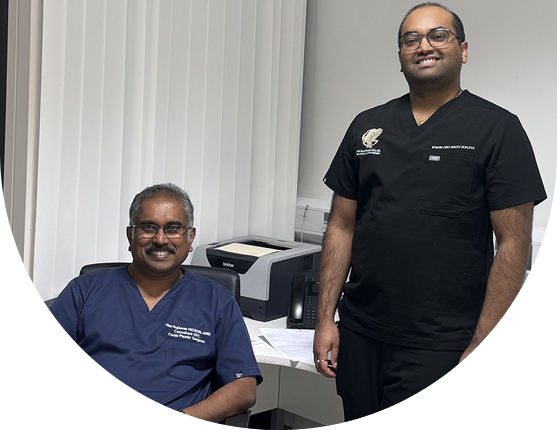
Two specialist facial plastic surgeons lead your care at Ullas Facial Plastic Surgery with extensive training in both aesthetic and reconstructive facial surgery.
Professor Ullas Raghavan is an internationally recognised facial plastic and reconstructive surgeon with decades of experience in complex facial surgery, including preservation deep plane facelift and neck lift techniques.
Mr Gautham Ullas is a UK-trained facial plastic surgeon with specialist expertise in facial rejuvenation, revision rhinoplasty and facial nerve reconstruction, offering a thoughtful and modern approach to facial surgery.
Book a Facial Palsy Consultation
Consultations at Ullas Facial Plastic Surgery are free and without obligation. Patients from across the UK and overseas are welcome to arrange an appointment to discuss treatment options in a calm, professional setting.
To book a consultation or speak with the team:
FAQ
Facial Palsy FAQs
How is facial palsy diagnosed?
At Ullas Facial Plastic Surgery, diagnosis combines a detailed clinical examination with an assessment of nerve function, and sometimes imaging or nerve conduction studies, depending on the suspected cause. We will also ask about when the weakness began and how it has changed over time, since this affects which treatments are suitable.
Can facial palsy be cured?
Whether facial palsy can be fully resolved depends on the cause and how long the weakness has been present. Some patients regain near-normal function with the right treatment, while others achieve significant improvement in symmetry and movement without complete resolution.
Is facial palsy treatment suitable for long-standing weakness?
Yes, treatment can still be effective even when facial weakness has been present for many years. We assess longstanding cases individually, since the right approach depends on how the nerve and muscles have adapted over time.
Can facial palsy affect eye closure?
Yes, facial nerve weakness can prevent the eye from closing fully, which affects both comfort and eye protection. This is assessed carefully during consultation, since protecting the eye is often an early priority in treatment planning.
Is facial palsy treatment available on the NHS?
Facial palsy treatment is available through the NHS in some cases, though waiting times and access to specialist facial nerve reconstruction can vary. A private consultation at Ullas Facial Plastic Surgery offers a faster route to specialist assessment and a broader range of treatment options.
What is synkinesis and can it be treated?
Synkinesis occurs when nerve fibres regrow abnormally after facial nerve damage, causing unwanted movements to accompany intended ones, such as the eye closing when smiling. It can be managed effectively with chemodenervation and targeted facial retraining.
What is the difference between static and dynamic facial reanimation?
Static procedures improve symmetry and support at rest but do not restore active movement, while dynamic reanimation aims to reintroduce genuine, controllable movement to the affected side. The right choice depends on nerve function, patient goals and overall suitability for surgery.
Does facial palsy treatment involve ongoing appointments?
Many facial palsy treatments, particularly chemodenervation for synkinesis, require repeat appointments every few months to maintain the effect. Surgical reconstruction is typically a one-time procedure, though follow-up continues while movement develops.
How long does facial palsy last?
Facial palsy can be temporary or permanent, depending on the underlying cause. Bell’s palsy often improves within weeks to months, while palsy caused by nerve injury, tumours or long-standing conditions may require active treatment to see meaningful improvement.
Will facial palsy treatment restore a completely normal smile?
The goal of treatment is meaningful, natural improvement rather than a guarantee of an entirely symmetrical smile, since outcomes depend on the extent of nerve damage. Your surgeon will discuss realistic expectations for your specific case during consultation.