
Midface Lifting Surgery

- Restores midface volume and definition
- Natural-looking facial rejuvenation
- All consultations free with no obligation
- Internationally trained specialist surgeons
- Complete aftercare included
Restoring Natural Midface Contour and Proportion
Midface lifting is surgery that restores the position and fullness of the middle third of the face: the cheeks, the area over the cheekbone, and the soft tissue that sits directly beneath the lower eyelids. When these deeper tissues descend, the cheek flattens, the distance between the lower lid and the cheek appears to lengthen, and the face can look drawn or tired even when nothing else has changed.
At Ullas Facial Plastic Surgery, midface lift surgery is planned around each patient’s bone structure, lower eyelid position, cheek volume and skin quality. The aim is to lift the midface back to where it used to sit, in a way that stays proportionate to the rest of the face, without the overfilled or pulled appearance that can follow volume-only or skin-only approaches.
About
What is Midface Lifting?
The midface is the middle third of the face. It runs from the lower eyelid down towards the upper lip, and it behaves as a single unit with the lower eyelid rather than with the brow above it. Within this area, the malar fat pad and the deeper tissue overlying the cheekbone are held in position by retaining ligaments. As those attachments weaken with age, the whole block of tissue slides downwards and slightly inwards.
Midface lifting reverses that movement. Rather than tightening skin or adding volume from outside, surgery releases the deeper tissue from its attachments and repositions it upwards over the cheekbone, where it is secured in its new position. Because the lift travels vertically rather than sideways, the cheek regains its own natural fullness and the face continues to move and express normally.
This content has been medically reviewed by Mr Gautham Ullas BMBS, BMedSci, FRCS (ORL-HNS).
What Conditions Can Midface Lifting Treat?
Because the cheek and the lower eyelid age as one connected unit, patients usually notice several of the following changes appearing together rather than in isolation. Treating them as a group tends to give a more balanced result than correcting a single feature on its own.
Midface lifting can address:
- Flattening, hollowing or loss of projection across the cheeks
- A lengthened or more visible transition between the lower eyelid and the cheek
- Descent of the malar fat pad, leaving the cheekbone less defined
- Deepening nasolabial folds caused by tissue settling downwards
- A tired or drawn appearance beneath the eyes
- Early midface descent that has not yet reached the jawline
Benefits
What are the Benefits of Midface Lifting?
Restoring the midface improves the part of the face people look at first. Because the correction comes from repositioning tissue that is already there, the result reads as a return to a previous version of the same face rather than an added or altered feature.
The benefits of midface lifting include:

Restored fullness and projection across the cheeks

A shorter, smoother transition from the lower eyelid into the cheek

Softening of the nasolabial folds

Improved cheekbone definition without added volume

A rested appearance that does not depend on repeated treatments

Long-lasting structural improvement with discreetly placed incisions
our Candidates
Am I a Good Candidate for Midface Lifting?

Suitable candidates are usually people who feel their cheeks have flattened or dropped, who notice the area beneath their eyes looking longer or more hollow than it used to, or who find that makeup and skincare no longer change how tired the middle of the face appears.
Suitability is confirmed individually during consultation, taking into account cheek volume, lower eyelid position, skin quality and the degree of descent present. Midface lifting may be carried out on its own or alongside other facial rejuvenation procedures, depending on each patient’s overall goals.
Midface Lift Surgery at a Glance
Duration of Surgery
1.5–2 Hours
Anaesthesia
General
Hospital Stay
Day Case
Pre-admission
No smoking/vaping x 6 weeks Off HRT/OCP x 6 weeks
Downtime
2 Weeks
Driving
7–10 Days
Time to Exercise
4-6 Weeks
Follow-Up
1 week / 2 weeks / 6 weeks / 6 months / 1 year
How Does Midface Lifting Work?
Surgery works beneath the skin rather than on it. The deeper tissue layers supporting the cheek are released from the retaining ligaments that hold them in their descended position, lifted upwards over the cheekbone, and fixed securely so that they heal in their new position. Skin is not pulled tight, which is what keeps the result looking natural.
Incisions are placed discreetly, most often within the temporal hairline, and the exact approach is chosen to suit each patient’s anatomy and the degree of correction required. Some patients need a more extensive release than others, so the plan reflects the specific pattern of midface descent present rather than a single fixed technique applied to everyone.
Your journey
Your Midface Lifting Treatment Journey at Ullas Facial Plastic Surgery
Every midface lift at Ullas Facial Plastic Surgery is planned individually, taking into account cheek volume, lower eyelid position and overall facial balance. The treatment journey is designed to give clarity and confidence at each stage.
Your consultation is free and carried out directly with a facial plastic surgeon, allowing time to assess cheek volume, midface position, lower eyelid support and skin quality, and to discuss suitable treatment options. A second complimentary consultation is also offered so you can reflect and ask further questions before deciding to proceed.
Surgery is typically performed under general anaesthesia. Incisions are placed discreetly, most often within the temporal hairline, allowing the surgeon to release and reposition the deeper tissue layers supporting the cheek. The procedure is planned to restore natural volume and position rather than pulling the skin tight.
Results become clearer as swelling subsides, with many patients noticing improved cheek fullness and a fresher appearance beneath the eyes during the early weeks of healing. Final results continue to settle over the following months as the repositioned tissues soften and heal into place.
Swelling and bruising across the cheeks and lower eyelids are common during the first one to two weeks, with gradual improvement as healing progresses. A firm or tight sensation in the cheek is normal for several weeks while the repositioned tissue settles. Most patients return to normal activities within a few weeks, and follow-up appointments are arranged to monitor healing and support recovery.
Risks
Midface Lifting Risks and Side Effects
As with any facial surgery, midface lifting involves a period of normal healing alongside a small number of less common risks, and your surgeon will talk through both in detail at consultation. Most patients experience some of the temporary side effects listed below, while the more serious risks, further down the list, are uncommon.
These can include:
- Swelling and bruising across the cheeks and lower eyelids
- Temporary numbness or tightness over the cheek
- A firm sensation in the cheek while the tissue settles
- Mild asymmetry while swelling resolves
- Scarring within the hairline, which generally fades
- Temporary changes in lower eyelid position, which usually settle as healing progresses
- Infection or delayed healing, which is uncommon
- Rare changes in facial sensation or movement
Feeling disconnected from your reflection? Frustrated by limited options for facial concerns others dismiss? Our dual-trained surgeons specialise in preservation deep plane facelifts and facial nerve reconstruction, delivering the natural-looking results you deserve. Experience renewed confidence as your appearance finally matches how you feel inside, with minimal downtime and compassionate expert care throughout your journey.
cost
How Much Does Midface Lifting Cost?
The cost of midface lifting depends on the extent of correction required, individual anatomy, and whether the procedure is carried out on its own or combined with other facial surgery. Following consultation, you will receive a clear quotation tailored to your treatment plan.

Flexible Options
Spread the cost with manageable monthly payments

Terms Available
Various payment terms to suit your circumstances

Regulated Provider
Finance provided through Pall Mall Medical
Our dedicated patient coordinator will discuss all available finance options during your consultation, helping you find a plan that works for your budget.
Choose Us
Why Choose Ullas Facial Plastic Surgery for Midface Lifting?
Rejuvenating the middle third of the face requires an understanding of how the cheek and the lower eyelid work together, as even small changes in cheek position alter how rested someone looks. At Ullas Facial Plastic Surgery, that relationship shapes every stage of planning, from the first consultation through to surgery itself.
Patients choose Ullas Facial Plastic Surgery because:

Specialist facial plastic surgeons focused exclusively on the face and neck

Surgical planning that treats the midface and lower eyelid as one connected unit

Consultations carried out directly with your surgeon, with realistic outcomes discussed honestly

Free first and second consultations, giving time to decide without pressure

A preference for natural repositioning over an overfilled or over-tightened appearance

Structured aftercare and follow-up throughout healing
Our Doctors
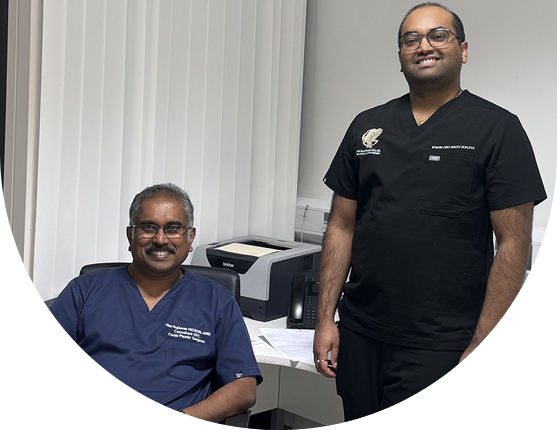
Meet Your Facial Plastic Surgeons
Book a Midface Lifting Consultation
Consultations at Ullas Facial Plastic Surgery are free and without obligation. Patients from across the UK and overseas are welcome to arrange an appointment to discuss treatment options in a calm, professional setting.
To book a consultation or speak with the team:
FAQ
Midface Lifting FAQs
What is the difference between midface lifting and a facelift?
Midface lifting treats the middle third of the face, lifting the cheek vertically back over the cheekbone. A facelift works lower down, addressing the jawline, jowls and neck. Patients with early changes limited to the cheeks often need only a midface lift, while those with laxity extending into the lower face are usually better served by a deep plane facelift, sometimes with the midface addressed at the same time.
Comparison of Midface Lift and Deep Plane Facelift Procedures
| Feature | Midface lift | Deep plane facelift |
|---|---|---|
| Area treated | Cheeks and the area beneath the lower eyelids, forming the middle third of the face | Lower face, jawline and neck, with the cheek lifted as part of a wider correction |
| What it corrects | Cheek flattening, midface descent and a lengthened lower eyelid to cheek transition | Jowling, loss of jawline definition and laxity through the lower face and neck |
| Direction of lift | Mainly vertical, repositioning tissue upwards over the cheekbone | Mainly oblique, redraping the deeper facial layers towards the ear |
| Typical incision placement | Concealed within the temporal hairline, tailored to patient anatomy | In front of and behind the ear, concealed in natural creases and the hairline |
| Commonly combined with | Lower blepharoplasty, brow lift or fat grafting | Neck lift, blepharoplasty or midface lift |
Note: The midface and the lower eyelid form a single unit within the middle third of the face, which is why midface lifting is frequently planned alongside lower eyelid surgery rather than in isolation.
How is midface lifting performed?
The procedure repositions deeper cheek tissue rather than simply tightening skin, working through incisions that are typically concealed within the temporal hairline. This allows the surgeon to release the structures holding the midface in a descended position, lift them vertically, and secure them so they heal where they have been placed.
Will midface lifting make my face look pulled or overfilled?
Not when it is planned carefully. An unnatural result usually comes from overcorrection or from a sideways pull, rather than from the technique itself. Surgical planning at Ullas Facial Plastic Surgery is deliberately aimed at a vertical, proportionate lift that restores the cheek without changing the character of the face.
How long does recovery take before I feel comfortable in public?
Most patients feel comfortable returning to normal social activities within two to three weeks, once the more visible swelling and bruising have settled. Subtle refinement continues gradually over several months afterwards, though this is rarely noticeable to others.
How long do the results of midface lifting last?
Results tend to be long-lasting because the deeper supporting tissue is repositioned rather than just the skin. Natural ageing continues in the background, but the structural improvement itself typically holds for many years.
Is midface lifting painful?
Most patients describe the discomfort as manageable rather than severe, more tightness and soreness than sharp pain, particularly in the first few days. Pain relief and clear aftercare guidance are provided to keep recovery as comfortable as possible.
Is midface lifting better than dermal fillers?
They do different things. Fillers add volume to a cheek that has dropped, whereas midface lifting moves the patient’s own tissue back to where it used to sit. For mild, early changes, non-surgical treatment can be enough, but where the midface has genuinely descended, repositioning tends to give a more natural contour and a far more durable result.
Can midface lifting be combined with other facial procedures?
Yes, it is often combined with eyelid surgery, a brow lift or a facelift, where that makes sense for the individual, so the whole face is treated with a consistent approach rather than one area looking noticeably different from the rest. This is discussed during consultation once your surgeon has assessed your facial anatomy as a whole.
What is the right age for midface lifting?
There is no fixed age. Suitability depends far more on how much the midface has descended than on a patient’s exact age, which is why some patients consider treatment in their forties and others wait considerably longer.
Will scars be visible after midface lifting?
Incisions are placed within the hairline or other well-concealed positions, so scarring is generally discreet from the outset. Most scars continue to soften and fade over the following months, and your surgeon will talk you through exactly where incisions will sit based on your hairline and anatomy.
Are midface lifting results permanent?
The structural repositioning achieved during surgery is long-lasting, though it does not stop the natural ageing process entirely. Most patients enjoy a noticeable, durable improvement that holds for many years, with only gradual changes as the face continues to age naturally afterwards.