
Scar Revision Surgery

- Tailored scar treatment
- Specialist facial scar expertise
- All consultations free with no obligation
- Internationally trained specialist surgeons
- Complete aftercare included
A Personalised Approach to Natural-Looking Scar Revision
Scars can form after injury, previous surgery or skin conditions, and while some fade naturally over time, others remain raised, tight, discoloured or noticeably different from the surrounding skin. Scar revision aims to improve the appearance and texture of a scar, helping it blend more naturally with the skin around it.
Facial and neck scars are assessed differently from scarring elsewhere on the body, since even a subtle irregularity is far more visible in this area. Ullas Facial Plastic Surgery brings the same anatomical precision used in facial surgery to scar revision, considering how a scar interacts with expression and movement, not just its appearance at rest.
About
What is Scar Revision?
Scar revision covers a range of surgical and non-surgical techniques used to improve how a scar looks and feels, from simple excision and careful re-suturing to laser treatment or steroid injections for raised or thickened scarring. The right approach depends on the type of scar present, and more than one technique is sometimes combined for the best result.
This content has been medically reviewed by Mr Gautham Ullas BMBS, BMedSci, FRCS (ORL-HNS).
What Types of Scars Can Be Treated?
Not all scars respond to the same treatment, which is why an accurate assessment of scar type is central to planning. Scar revision at Ullas Facial Plastic Surgery is tailored to the specific pattern of scarring present.
Scar revision can address:
- Raised or thickened (hypertrophic) scars
- Keloid scars
- Sunken or indented scars
- Wide or stretched scars
- Scars that pull or restrict movement
- Discoloured or noticeably textured scars
- Scars from previous facial surgery
Keloid scars, which grow beyond the edges of the original wound, behave differently from hypertrophic scars and are approached with particular care because surgery alone can make them recur. The NHS guidance on keloid scars explains the difference and the treatments available.
Benefits
What are the Benefits of Scar Revision?
A scar in a visible area of the face can affect confidence long after the original injury or surgery has healed, particularly if it remains raised, discoloured or easily noticed by others. Treating a scar directly, rather than relying on makeup or styling to conceal it, can make a lasting difference.
The benefits of scar revision include:

A flatter, smoother scar texture

Reduced redness or discolouration

Improved blending with the surrounding skin

Restored movement where a scar has caused tightness

Long-lasting improvement in scar appearance

A treatment plan suited to your specific type of scarring
our Candidates
Am I a Good Candidate for Scar Revision?

Scar revision may suit anyone with a facial or neck scar that has fully healed but remains noticeable, whether that scar is from an old injury, previous surgery or a skin condition. Timing matters, since some scars continue to soften naturally over twelve to eighteen months, and your surgeon will advise whether it is best to wait or proceed sooner based on the type of scar involved.
Scar Revision Surgery at a Glance
Duration of Surgery
30 Minutes–2 Hours
Anaesthesia
Local or General
Hospital Stay
Day Case
Pre-admission
No smoking/vaping x 6 weeks Off HRT/OCP x 6 weeks
Downtime
1-2 Weeks
Driving
7–10 Days
Time to Exercise
4-6 Weeks
Follow-Up
1 week / 2 weeks / 6 weeks / 6 months / 1 year
How Does Scar Revision Work?
The technique used for scar revision depends entirely on the type of scar being treated. Raised or thickened scars often respond well to steroid injections or laser treatment, while wide, uneven or poorly positioned scars may be surgically excised and closed again with more precise technique, sometimes repositioning the scar to sit along a more natural skin crease.
Where a scar is causing tightness or restricting movement, additional techniques such as tissue rearrangement may be used to release the affected area. Your surgeon will explain exactly which combination of techniques is recommended for your scar once it has been assessed in person.
Your journey
Your Scar Revision Treatment Journey at Ullas Facial Plastic Surgery
Every scar revision plan at Ullas Facial Plastic Surgery is built around the specific scar being treated. The treatment journey is designed to give clarity and reassurance at each stage.
Your consultation is free and carried out directly with a facial plastic surgeon, who will examine your scar in person to determine the most suitable technique. A second complimentary consultation is also available if you would like more time to consider your options.
Depending on the technique recommended, treatment may be performed under local anaesthetic in clinic or, for more involved surgical revision, under general anaesthetic. Your surgeon will confirm exactly what to expect once your treatment plan has been agreed upon.
Non-surgical treatments such as steroid injections or laser therapy often show gradual improvement over several sessions, while surgically revised scars continue to soften and flatten over several months as healing progresses. Patience is often needed, since scars rarely reach their final appearance immediately.
Recovery depends on the technique used, ranging from minimal downtime for injection-based treatments to a short recovery period following surgical revision. Follow-up appointments are arranged to monitor healing and adjust the treatment plan if further sessions are needed.
Risks
Possible Risks or Side Effects of Scar Revision
As with any scar treatment, scar revision involves a period of normal healing alongside a small number of less common risks, and your surgeon will explain both fully at your consultation. Most patients experience some of the temporary side effects below, while the risks further down the list are uncommon.
These can include:
- Temporary redness or swelling at the treatment site
- Temporary changes in skin sensation
- A new scar line following surgical revision, which usually settles well
- Under or over correction requiring a further session
- Infection or delayed healing, which is uncommon
- Rare recurrence of a thickened or raised scar
Feeling disconnected from your reflection? Frustrated by limited options for facial concerns others dismiss? Our dual-trained surgeons specialise in preservation deep plane facelifts and facial nerve reconstruction, delivering the natural-looking results you deserve. Experience renewed confidence as your appearance finally matches how you feel inside, with minimal downtime and compassionate expert care throughout your journey.
cost
How Much Does Scar Revision Cost?
The cost of scar revision depends on the technique recommended and whether treatment is surgical or non-surgical, as well as the size and complexity of the scar involved. Following consultation, you will receive a clear quotation tailored to your treatment plan.

Flexible Options
Spread the cost with manageable monthly payments

Terms Available
Various payment terms to suit your circumstances

Regulated Provider
Finance provided through Pall Mall Medical
Our dedicated patient coordinator will discuss all available finance options during your consultation, helping you find a plan that works for your budget.
Choose Us
Why Choose Ullas Facial Plastic Surgery for Scar Revision?
Facial and neck scars call for a level of precision that reflects how visible this area is, since even a well-healed scar can draw attention if its texture or position is not carefully considered. At Ullas Facial Plastic Surgery, scar revision is planned with the same anatomical detail applied to facial surgery more broadly.
Reasons patients choose Ullas Facial Plastic Surgery for scar revision include:

Techniques chosen to blend naturally with the surrounding skin

Experience treating scars in structurally sensitive areas, including the lips and eyelids

Every scar is assessed and planned individually

Honest guidance on what improvement is realistically achievable

One named point of contact from consultation through to follow-up

Free first and second consultations, with no pressure to proceed
Our Doctors
Meet Your Facial Plastic Surgeons
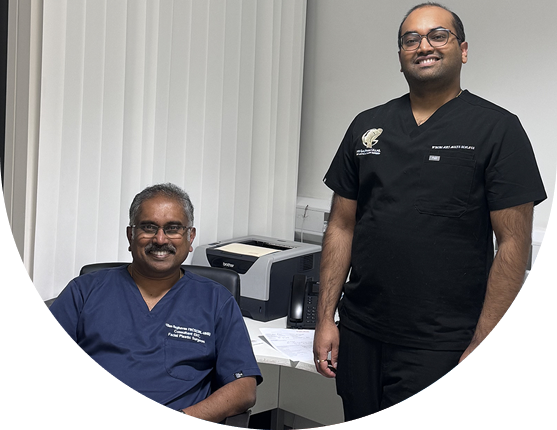
Two specialist facial plastic surgeons lead your care at Ullas Facial Plastic Surgery with extensive training in both aesthetic and reconstructive facial surgery.
Professor Ullas Raghavan is an internationally recognised facial plastic and reconstructive surgeon with decades of experience in complex facial surgery, including preservation deep plane face lift and neck lift techniques.
Mr Gautham Ullas is a UK-trained facial plastic surgeon with specialist expertise in facial rejuvenation, revision rhinoplasty and facial nerve reconstruction, offering a thoughtful and modern approach to facial surgery.
Book a Scar Revision Consultation in Manchester
Consultations at Ullas Facial Plastic Surgery are free and without obligation. Patients from across the UK and overseas are welcome to arrange an appointment to discuss treatment options in a calm, professional setting.
To book a consultation or speak with the team:
FAQ
Scar Revision FAQs
How soon after an injury or surgery can scar revision be performed?
At Ullas Facial Plastic Surgery, we generally recommend waiting at least twelve months after the original injury or surgery, since many scars continue to soften naturally during this period. Treating too early can sometimes mean revising a scar that would have improved further on its own. However, if a scar is obviously wide or distorting there may be room for earlier intervention. If you are in doubt, we can guide you during the consultation.
Is scar revision suitable for scars from acne or skin conditions?
Yes, scar revision techniques, including laser treatment, can also improve scarring caused by acne or other skin conditions, not just injury or surgery. The right approach depends on the depth and pattern of scarring present.
Can scar revision be combined with other facial procedures?
Yes, scar revision can be combined with other facial procedures where appropriate, particularly if a scar sits within an area being treated for another reason. This is planned individually during consultation.
Can steroid injections alone improve a raised scar?
Yes, steroid injections alone can meaningfully soften and flatten many raised or hypertrophic scars, particularly when started at the right stage of healing. Several sessions are often needed to achieve the full effect.
How many sessions of scar revision are usually needed?
The number of sessions depends on the type and severity of the scar, ranging from a single surgical revision to a series of injections or laser sessions spaced several weeks apart. Your surgeon will outline an expected timeline once your scar has been assessed.
Can scar revision completely remove a scar?
Scar revision aims to significantly improve how a scar looks and feels, but it cannot guarantee complete removal, since some trace of the original scar usually remains. Your surgeon will discuss a realistic outcome based on your specific scar during consultation.
Will a revised scar look different to my original scar?
A revised scar is designed to be flatter, less visible and better blended with the surrounding skin, though it will not disappear entirely. Repositioning a scar along a natural crease, where possible, also helps it sit less obviously.
Does scar revision hurt?
Non-surgical treatments such as injections are generally well tolerated with minimal discomfort, while surgical revision involves similar sensations to any minor procedure under local or general anaesthetic. Pain relief and aftercare guidance are provided to keep recovery comfortable.
How long does it take for a scar to fully heal after revision?
Visible healing usually settles within a few weeks, though scars continue to soften and flatten gradually for up to twelve months afterwards. The final result is rarely apparent immediately after treatment.
What can I do to support healing after scar revision?
Keeping the treated area protected from sun exposure and following your surgeon’s aftercare instructions closely both support the best possible healing. Avoiding smoking and staying well hydrated can also help scars heal and settle more effectively.